
Learn the best battery backup for home options, compare top features, and pick the right system for reliability and savings in your California home.
Date
Dec 12, 2025
Author
RC Admin
Read
8 min
When you're trying to find the best battery backup for your home, it's not about finding a one-size-fits-all solution. It’s about matching the right system to your specific life—your home's size in Los Angeles or Ventura County, which appliances you can't live without during a power outage, and of course, your budget.
For those of us in California dealing with the constant threat of wildfires and Public Safety Power Shutoffs (PSPS), a reliable system is non-negotiable. Whether it's a solar-powered battery or a hybrid setup with a Generac standby generator, the goal is true energy independence and the peace of mind that comes with it. This guide is your practical roadmap to getting there.
Your Guide to Uninterrupted Power in California
Let’s face it, for homeowners in Los Angeles and Ventura County, power outages have become a frustratingly common part of life. Between fire season, planned PSPS events, and a grid that’s showing its age, the need for a solid backup power plan has never been more obvious. This guide is here to cut through the technical jargon and get right to what you need.
We’ll dig into why home battery backup systems are fast becoming the go-to choice for so many. They offer a silent, seamless, and increasingly cost-effective way to keep your home running. Unlike portable generators, a whole-home system installed by a professional electrician gives you automatic, uninterrupted power the second the grid fails. RC Generators specializes in installing permanent home backup solutions, including Generac generators and home battery systems, to restore power during fires, hurricanes, and more.
Why a Home Backup System Is Essential
Here in California, grid instability isn't just a headline—it's a real problem. A home battery backup system is your best defense against these disruptions. Here’s what makes it such a critical investment for local homeowners:
Instantaneous Power: The moment the grid goes down, your battery system kicks in. There's no delay. Your lights, Wi-Fi, refrigerator, and other essentials just keep running without a flicker.
Silent Operation: Forget the constant roar of a fuel-powered generator. Battery systems are nearly silent, which makes a stressful outage feel a lot less chaotic.
Energy Independence: This is a big one. When you pair a battery with solar panels, you can store the clean energy you generate during the day. This cuts down your reliance on the utility company and insulates you from ever-rising electricity rates.
Enhanced Safety: A professionally installed system, like the ones we handle at RC Generators and Electric, is wired directly into your home. That means no more fumbling with extension cords or storing flammable fuel.
This article will walk you through everything, comparing different types of systems, showing you how to figure out your energy needs, and explaining how they integrate perfectly with solar panels or a Generac home standby generator.
A battery's main job might be storing solar energy, but its real value shines during an outage. That ability to provide instant, silent backup power is a game-changer for any homeowner who can't afford a disruption.
To get you started, let's look at the key factors that will steer your decision. This table breaks down the essential questions you should be asking yourself when choosing the best battery backup for your home.
Key Factors for Your Home Battery Backup Decision
Use this table as a quick reference to the essential criteria for selecting the right battery backup system for your home.
Decision Factor | Why It Matters | Key Questions to Ask Yourself |
|---|---|---|
Outage Tolerance | This determines how much battery storage you'll need. | Can I get by for a few hours, or do I need enough power to last through a multi-day PSPS event? |
Essential Appliances | This dictates the power your system must deliver. | What absolutely has to stay on? Is it just the fridge and Wi-Fi, or do I need medical devices, the AC, or the entire house powered? |
Solar Integration | This affects the type of system you choose and your long-term savings. | Do I already have solar panels, or is that something I plan to add down the road? |
Future Needs | A little foresight ensures your system can grow with you. | Am I thinking about getting an electric vehicle or adding a new heat pump or other major appliance soon? |
Our goal is simple: to give you the confidence you need to pick the right system to protect your home and family.
Ready to secure your home's power? Contact RC Generators and Electric today for a professional site assessment.
Comparing Your Home Battery Backup Options
Diving into the world of home batteries can feel a little overwhelming at first, but it really boils down to a few key decisions. The right system for your home in Los Angeles or Ventura County depends entirely on what you want to achieve, whether that's total energy independence or just keeping the lights on during an outage.
The first big question is whether you already have solar panels installed. Your answer will immediately point you toward either an AC-coupled or a DC-coupled system. Don't worry about the technical terms; think of it like a fork in the road—one path is designed for existing solar, the other for new, combined installations.
This flowchart gives a quick visual of how to start thinking about the process, factoring in your home's size, how you plan to use the battery, and your budget.
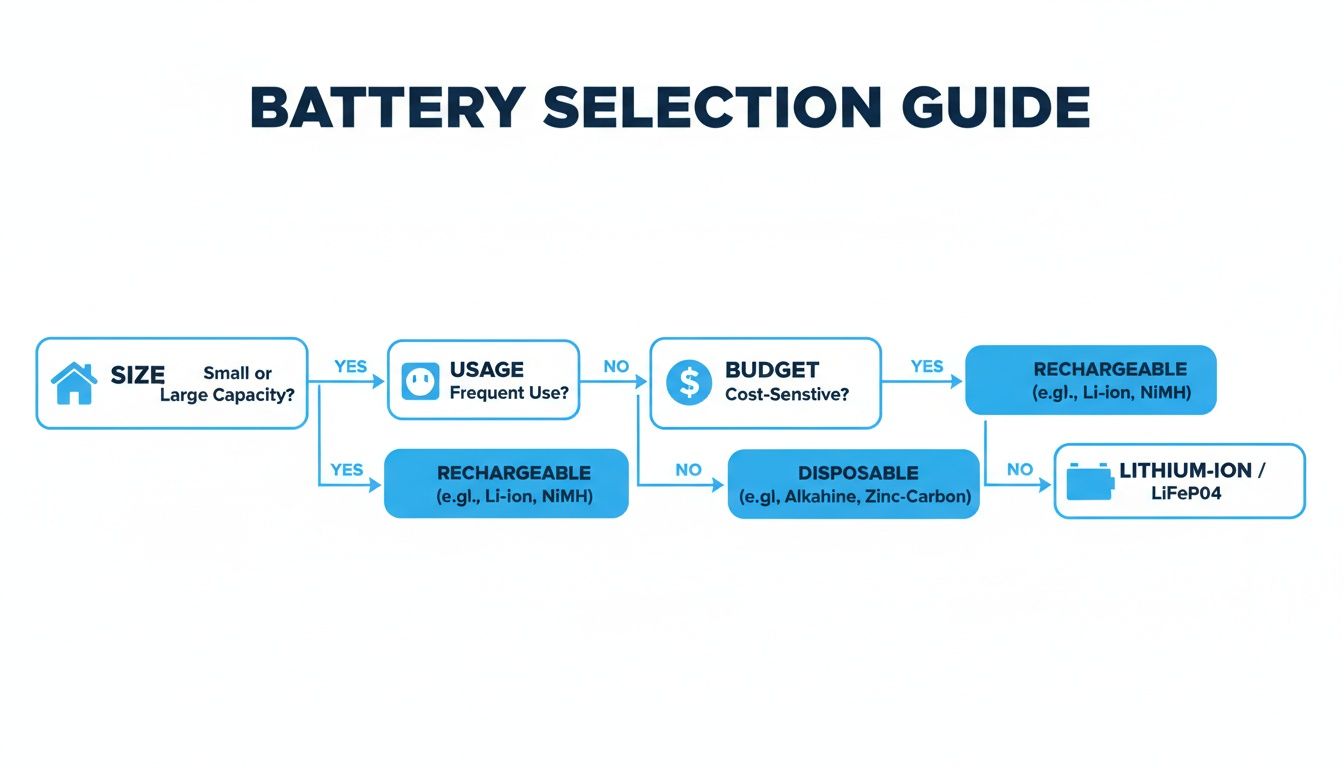
As you can see, getting a clear picture of your energy needs is the first step. It’s the foundation for choosing a battery that’s powerful enough without being overkill.
AC-Coupled vs. DC-Coupled Systems
If you’ve already got a solar panel system up and running, an AC-coupled battery is almost always the simplest way to add storage. It connects right into your home's main electrical panel and works alongside your existing solar equipment. This makes for a much smoother and more affordable installation.
On the other hand, if you're installing solar and a battery at the same time, a DC-coupled system is the way to go. Here, the solar panels and the battery share a single, specialized piece of equipment. This setup is more efficient because the power from your panels flows directly into the battery without needing to be converted multiple times, which always results in some energy loss.
Integrated vs. Modular Solutions
Another important choice is between an integrated or a modular battery system. An integrated system is a true all-in-one unit. The battery and all the smart electronics are housed in one sleek package. This approach guarantees every component is perfectly matched and simplifies the installation process.
A modular system gives you more flexibility. You can start with just one or two battery modules and easily add more down the road if your needs change—say, you buy an electric vehicle or add an extension to your home. This scalability is a huge plus for anyone looking to future-proof their investment. While it might involve a few more separate components, it lets you build a system that’s perfectly tailored to your life.
The real question between integrated and modular comes down to your long-term vision. If you think your energy consumption might grow over time, a modular battery gives you an upgrade path without having to replace the entire system.
The demand for these systems is growing fast. Homeowners are tired of grid instability and are turning to renewable energy for security. The global market for home energy storage is projected to jump from $3.37 billion in 2026 to $6.89 billion by 2034. That’s a lot of people deciding to take control of their power.
Ultimately, whether you need a simple battery to complement your existing solar or a comprehensive system you can expand over time, there's a perfect solution out there. To get a better handle on how these different setups work, take a look at our deep dive on energy storage systems for homes.
Sizing Your System for California's Power Outages
Figuring out the right size for a home battery backup starts with a straightforward but essential question: what absolutely has to stay on when the grid goes down? Getting this right is the difference between overspending on a system you’ll never use and, worse, finding yourself powerless when it matters most. A quick energy audit is the first step toward true energy independence.
Think about your non-negotiables. For most homeowners in our area, the list includes the refrigerator, the Wi-Fi router, a few lights, and maybe some critical medical equipment. Each of these draws a specific amount of power, and adding them up gives you a realistic baseline for your needs.
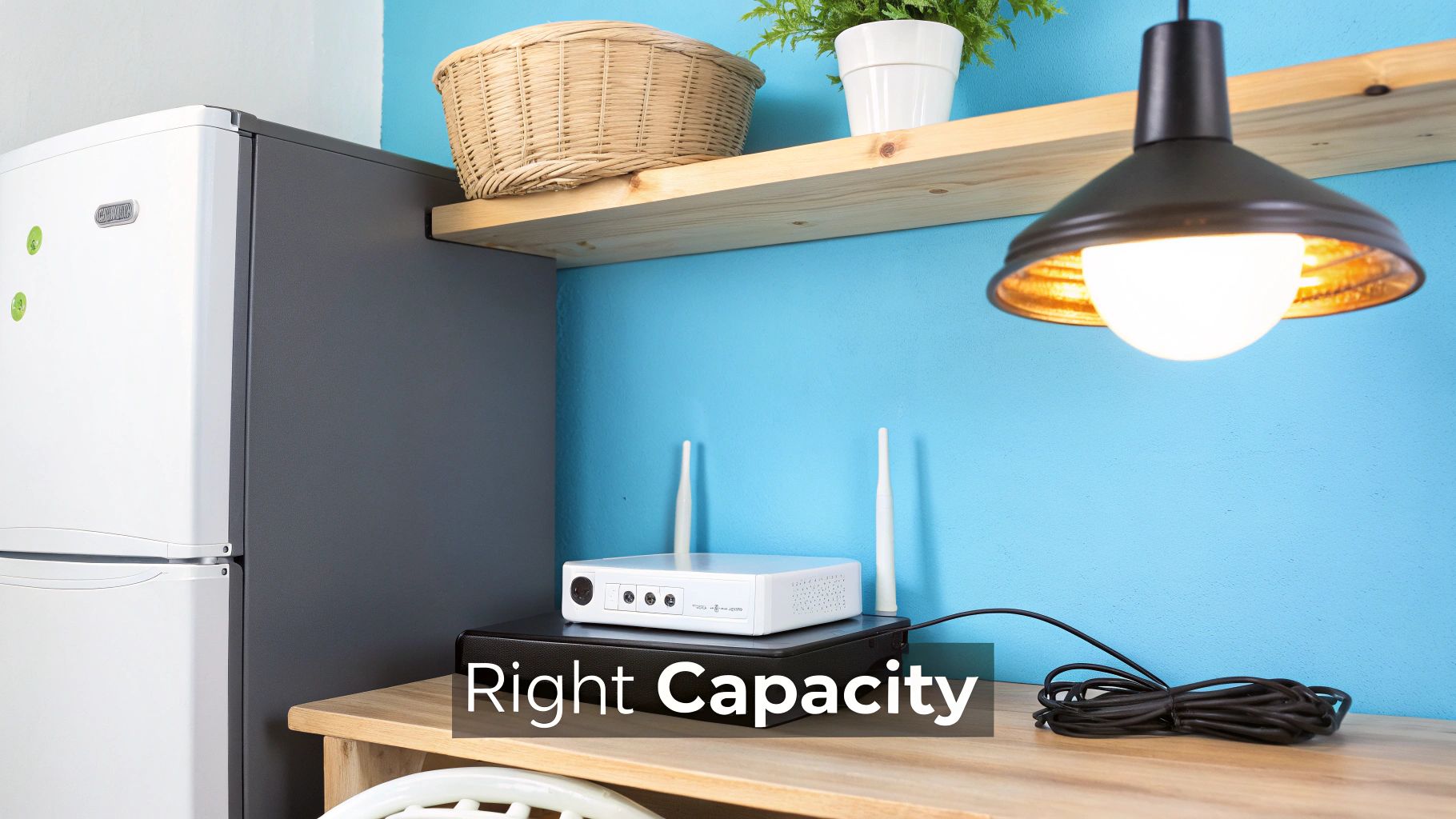
This initial math helps you understand not just how much power you need at any given moment, but also how long a particular battery can keep things running. This is where your outage tolerance comes into play.
Planning for Short-Term vs. Long-Term Outages
Here in Los Angeles and Ventura County, we deal with two completely different kinds of power disruptions. Knowing which one you’re planning for will directly impact the size of the battery system you’ll want.
Short-Term Backup: This approach is all about getting through those brief, unexpected outages that last a few hours. The goal is to keep the essentials—like your internet, fridge, and some lights—humming along without a flicker. A smaller, more budget-friendly battery system is often the perfect fit here.
Multi-Day Independence: If your bigger concern is surviving an extended Public Safety Power Shutoff (PSPS) or a major grid failure, the focus shifts to long-term resilience. This demands a much larger battery, almost always paired with solar panels to recharge it daily. This kind of setup lets you run more significant appliances and maintain a real sense of normalcy for days on end.
The key is to match your investment to your primary worry. If you just need to keep the home office online for an afternoon, a massive system built for a week-long outage is probably overkill.
Calculating Your Essential Loads
To get a real-world idea of what you need, let’s look at some common household appliances and what they typically draw. This will help you visualize what a battery is up against.
Appliance | Average Power Consumption (Watts) |
|---|---|
Refrigerator/Freezer | 150 - 200 watts (running) |
Wi-Fi Router & Modem | 10 - 20 watts |
LED Lights (per room) | 30 - 60 watts |
Laptop & Phone Chargers | 50 - 100 watts |
CPAP Machine | 30 - 60 watts |
Television (55-inch LED) | 80 - 150 watts |
As you can see, the basics don't pull a ton of power individually. But the math changes quickly when you start adding heavy hitters like an air conditioner (1,500-3,500 watts) or an electric vehicle charger. The required battery capacity shoots up fast.
The rise of electric vehicles in California has added a new dimension to sizing a home battery. Charging an EV can easily double a home's daily energy consumption, making it a critical factor in designing a system that won't leave you stranded.
Ultimately, a bigger battery system offers more than just a longer runtime—it gives you flexibility. It means you can run the A/C during a brutal heatwave or top off your EV overnight, even when the rest of the neighborhood is dark. That level of preparedness is what elevates a simple backup system into a complete home energy solution.
Properly sizing your system is the most important step in finding the best battery backup for your home. The experts at RC Generators and Electric can perform a detailed site assessment to analyze your unique energy needs and recommend a perfectly sized system.
Ready to find out exactly what your home needs? Contact RC Generators and Electric today to schedule your professional energy audit and take the first step toward uninterrupted power.
Generac Generators and Battery Backup: A Hybrid Solution
For homeowners who simply can't afford to be without power, pairing the best home battery backup with a powerful generator creates the ultimate energy shield. While a standalone battery is a fantastic solution for short-term hiccups, combining it with a Generac home standby generator offers a level of resilience that neither system can touch on its own. This hybrid approach is really the gold standard for total peace of mind.
Picture this: the grid in your Los Angeles neighborhood goes down. Instantly and silently, your home battery takes over, keeping your essential appliances humming without a flicker. Your lights stay on, the Wi-Fi is active, and the fridge keeps running. That immediate, quiet power is the battery's greatest strength.
This seamless switch provides comfort and keeps things normal for the first few hours of an outage. But for those longer disruptions, like a multi-day Public Safety Power Shutoff (PSPS) event, the battery’s stored energy will eventually run low. This is exactly where the hybrid system proves its unbeatable value.
The Best of Both Worlds: An Unbeatable Power Shield
A hybrid system is smart. It knows how to manage your power resources. Once the battery's charge dips to a set level, the Generac standby generator automatically senses the need and kicks on. Within seconds, it’s shouldering the electrical load of your entire home, from the air conditioning to the oven.
But it doesn't stop there. While the generator is powering your home, it's also recharging your battery backup. This means that once the generator’s cycle is complete, your battery is full and ready to provide silent power all over again. This cycle can repeat for as long as the outage lasts, giving you virtually unlimited power.
This two-stage defense offers some clear advantages:
Instant, Silent Power: The battery handles the immediate switch, so there's no power interruption and no noise.
Long-Term Endurance: The Generac generator does the heavy lifting for extended outages, making sure you never run out of juice.
Fuel Efficiency: By letting the battery handle the short-term needs, the generator runs less often, which saves fuel and cuts down on operational costs.
Complete Home Coverage: While a battery might be sized just for the essentials, the generator can power your entire home. No compromises needed.
A hybrid strategy is the top choice for homeowners who need 100% uptime. It combines the instant response of a battery with the long-running, high-capacity power of a standby generator, covering every possible outage scenario.
Why This Is a Game-Changer for California Homeowners
In areas like Ventura County that are prone to wildfires and PSPS events, you never know how long an outage will last. A hybrid system takes that uncertainty off the table. You get the immediate, clean power from your battery for the first few hours—which is often all you need. For those stubborn outages that stretch into days, the Generac generator provides the heavy-duty, reliable power needed to live normally.
This combination is especially critical for homes with big power demands, like those with electric vehicles, home medical equipment, or large AC systems. The battery handles the initial load, and the generator ensures these power-hungry appliances can run indefinitely. By integrating these two powerful solutions, you're essentially building an energy fortress around your home.
To get a better sense of what makes these generators such a cornerstone of home energy security, take a look at the many benefits of a Generac standby generator in our detailed guide.
At RC Generators and Electric, we specialize in designing and installing these comprehensive hybrid systems. Our experts can evaluate your home's unique energy profile and engineer a seamless solution that integrates a battery backup with a Generac generator for unmatched reliability.
Don't leave your family's comfort and safety to chance. Contact RC Generators and Electric today to discuss a hybrid power solution that will keep your home powered through any outage, guaranteed.
Understanding Costs and California Incentives
Making a smart investment in a home battery backup system really starts with understanding the full financial picture. For homeowners here in Los Angeles and Ventura County, the initial price tag is just one piece of a much larger—and more favorable—equation. While a quality system is a significant purchase, it’s more accessible than ever thanks to some powerful financial incentives and long-term savings.
The upfront cost of a home battery can vary quite a bit based on its storage size, brand, and how complex the installation is. A smaller system designed to just power essential circuits during brief outages will naturally be more affordable than a larger, multi-battery setup built for multi-day energy independence. We'll break down these costs and, more importantly, how state and federal programs can slash them.
Breaking Down the Investment
When you get a quote for a battery system, it typically includes the cost of the battery itself, the necessary electronics, a smart controller, and the professional installation labor. While portable generators might seem cheaper at first glance, their long-term value just doesn't compare to a permanent battery solution installed by a professional.
In 2025, battery backup systems are quickly overtaking traditional home generators in both popularity and market preference. This shift is driven by dramatic cost reductions and far superior efficiency. According to recent industry analysis, a typical 20kWh battery backup system costs between $15,000 and $25,000 upfront. But its operational expenses are as low as $50-$100 annually with zero fuel costs if you pair it with solar charging, giving you a lifespan of 15-20 years.
On the other hand, a 7kW portable generator runs from $800-$1,500 initially but racks up $100-$200 in maintenance every year, plus $30-$100 in fuel for every single outage. And it only lasts 5-10 years. You can learn more about these home power trends to see the full picture.
Unlocking Major Savings with California Incentives
This is where the investment becomes truly compelling for California residents. We have several programs designed to make energy storage more affordable, significantly cutting your out-of-pocket expenses.
The Federal Solar Tax Credit (ITC): This is the biggest one. It lets you claim a tax credit for 30% of the total cost of your battery system, including installation. The key requirement is that the battery must be charged by an on-site renewable energy source, like your solar panels.
Self-Generation Incentive Program (SGIP): This is a California-specific rebate program that gives you cash back for installing a new energy storage system. The rebate amount varies, but it can be substantial, especially for homeowners in high fire-threat districts or those who experience frequent PSPS events.
These incentives aren't just minor discounts; they can reduce the total cost of your system by thousands of dollars. The SGIP program, in particular, is structured to help those most affected by grid instability, making true energy resilience much more attainable.
By stacking the federal ITC and the SGIP rebate, a system that initially looks expensive can become a very financially savvy upgrade for your home. These programs are in place because the state recognizes that investing in the best battery backup for your home is also an investment in a stronger, more resilient community grid.
The experts at RC Generators and Electric are deeply familiar with these programs. We can guide you through the entire application process to make sure you maximize every dollar of your savings.
Don't let the initial numbers keep you from securing your home's power. Contact RC Generators and Electric today for a free estimate and to learn exactly how much you can save with California's incentives.
Why Professional Installation Is Non-Negotiable
When it comes to your home’s battery backup, picking the right model is only half the battle. How it’s installed is just as critical—if not more so. While the DIY spirit is great for many home projects, installing a high-voltage energy storage system is a complex job that absolutely demands a certified expert. This isn't just about connecting a few wires; it's about protecting your home, your family, and your investment.
An improper installation can create a minefield of problems. You could face immediate dangers like electrical shorts and fire hazards, or long-term issues that could damage your battery, your home's electrical panel, or your appliances. On top of that, almost every manufacturer, including top-tier brands like Generac, will void their warranty if the system isn’t installed by a licensed and certified pro. That leaves you on the hook for any failures down the road.
The Professional Installation Process
A professional installation isn’t a rushed job. It’s a careful, methodical process that ensures your system runs safely and flawlessly for years to come, leaving zero room for error.
Here’s what to expect when you work with an experienced team:
Thorough Site Assessment: First, an expert evaluates your home’s electrical panel, existing wiring, and the physical space to find the perfect spot for the battery and its components.
Custom System Design: Based on that assessment, the installer designs a system tailored to your home’s specific energy needs and backup goals.
Permitting and Code Compliance: Navigating building codes in Los Angeles or Ventura County can be a headache. A professional handles all the permits and guarantees the installation meets every local and national electrical standard.
Safe and Secure Connection: The team will safely integrate the battery with your main electrical panel and, if you have one, your solar array or Generac generator, creating a seamless and secure connection.
Warranty, Efficiency, and Peace of Mind
Beyond the obvious safety benefits, professional installation is the only way to make sure your system operates at peak efficiency. Certified installers know the exact configurations needed to maximize your battery's output and lifespan, so you get the reliable power you paid for, especially during a crisis. The trend toward professional-grade systems is undeniable. Here in California, battery adoption with solar has skyrocketed, with over 50% of new residential solar installations including storage by 2024. This growth is fueled by homeowners who want reliable whole-house backups from trusted brands that require expert installation.
Choosing a certified installer isn’t just an extra cost—it’s a critical part of the system itself. It’s what activates your warranty, guarantees performance, and gives you the ultimate peace of mind that your home is truly protected.
No matter the home system, understanding the importance of professional services for your home is key to ensuring safety and long-term reliability. At RC Generators and Electric, our licensed electricians aren't just installers; they're energy solution experts. We specialize in designing and implementing whole-home battery backup systems that provide dependable, uninterrupted power right when you need it most.
Ready to make sure your battery backup is installed correctly from day one? Contact RC Generators and Electric today for a professional consultation and a flawless installation.
Common Questions About Home Battery Backups
Diving into home energy storage brings up a lot of questions. As you start looking for the right battery backup for your home in Los Angeles or Ventura County, here are some clear, direct answers to the things we hear most often.
How Long Does a Home Battery Last During a Blackout?
This really comes down to two things: the battery’s storage size and what you’re actually running in your house. A standard 15 kWh system, for example, can comfortably power essentials like your fridge, Wi-Fi, and lights for anywhere from 12 to 24 hours.
Of course, if you’re just keeping a few critical devices on, you’ll get a lot more time. But if you fire up a power-hungry appliance like an air conditioner, that runtime will drop. The only way to know for sure is with a professional site assessment, where we can match a battery’s capacity to your specific needs.
Can I Add a Battery to My Existing Solar Panels?
Yes, absolutely. In fact, it's one of the most common and smartest upgrades California homeowners are making. Systems that use AC-coupled batteries were designed for exactly this. They tie in seamlessly with your existing solar setup, letting you bank all that extra energy your panels produce during the day. Then you can use it at night or, more importantly, during a power outage.
Do Home Batteries Need a Lot of Maintenance?
Not at all. This is one of their biggest selling points, especially when you compare them to fuel-powered generators. Home batteries are pretty much a set-it-and-forget-it solution.
Unlike generators that need oil changes, fuel checks, and regular engine service, a battery system works quietly in the background with zero ongoing upkeep. You might get an occasional software update, but that’s it. The days of scheduling annual engine maintenance are officially over.
Are Battery Backups Noisy Like Generators?
Nope, and for many people, this is a total game-changer. Home battery systems are nearly silent. During an outage, you won't hear a thing, which makes a stressful situation a lot more peaceful. This is a huge contrast to the constant, loud rumble of even the quietest standby generators, like those from Generac. With a battery, the only way you'll know the power is out is that all your stuff is still on.
Ready to find a quiet, reliable power solution that just works? The expert electricians at RC Generators and Electric are here to design and install a system that gives you true peace of mind.
Contact us today to schedule your professional site assessment!