
Get the electric vehicle charger installation cost in California explained: find typical price ranges, what affects price, and tips to save on your install.
Date
Oct 23, 2025
Author
RC Admin
Read
6 min
So, you’re making the jump to an electric vehicle. It’s an exciting move, but it brings up one big, practical question for California homeowners: what’s it really going to cost to get a home charger installed?
Figuring out the budget ahead of time is the key to a smooth process. You can generally expect a standard Level 2 home setup in California to land somewhere between $1,200 and $2,500. This number covers the charger itself, the electrician’s time, and the necessary permits, but it can climb if your home’s electrical system needs a little extra attention.
Your Guide to EV Charger Installation Costs in California
Think of the final price as a puzzle with a few key pieces. Understanding how they all fit together helps you know what to expect and where your money is going. It prevents any last-minute surprises when the final bill arrives.
Breaking Down the Core Costs
When you get a quote for your installation, it’s not just for the charger you see on the wall. The price is a combination of the hardware, the skilled labor needed to install it safely, and the administrative steps required to keep everything up to code.
These costs aren’t the same everywhere. As an interesting comparison, the price to install an EV charger in a different market, like India, can range from INR 50,000 to INR 1,50,000 for a Level 2 unit. If you wanted a powerful DC fast charger, that could jump to over INR 10,00,000 thanks to different hardware and permit rules. You can find more details on these global cost differences over at PulseEnergy.io.
But for right here in California, let’s look at a typical breakdown for a Level 2 installation—the go-to choice for most homeowners.
Estimated Level 2 EV Charger Installation Cost in California
This table gives you a solid idea of what to budget for a standard Level 2 home charger project. It shows how the different parts of the installation contribute to the final price.
Cost Component | Typical Price Range (USD) |
|---|---|
Level 2 Charger Unit | $400 - $800 |
Professional Labor & Materials | $600 - $1,300 |
City/County Permits | $150 - $450 |
Estimated Total | $1,150 - $2,550 |
This breakdown should help you see where every dollar goes, making the whole process feel much more transparent.
Understanding Each Component
Each one of those line items is essential.
The charger unit is the physical hardware you’ll use every day. Professional labor covers the expertise of a licensed electrician who will run new wiring from your electrical panel, install a dedicated circuit breaker, and connect everything safely. Finally, permits are non-negotiable in most California cities; they’re how the county or city verifies the work was done right and meets strict safety codes.
An important note: This table assumes your home has a modern electrical panel with enough capacity to handle the new load. If your panel is old or already maxed out, you might need an upgrade, which would be an additional cost.
This gives you a clear starting point for budgeting. Keep in mind, factors like how far your garage is from your electrical panel can nudge the final price up or down.
Ready to get a precise quote for your California home? The experts at RC Generators and Electric can give you a detailed assessment and handle your entire Tesla or EV charger installation from start to finish. Contact us today for a personalized consultation.
Choosing Your Home EV Charger Level
Before we can even start talking about your electric vehicle charger installation cost, we need to figure out which type of charger is right for you. They aren't all created equal, and the one you pick is the single biggest factor that will shape the scope and budget of your project.
Think of them as different tools for the same job—getting power into your car. For home use here in California, you're really only looking at two of the three main "levels," and each one strikes a different balance between speed, convenience, and cost.
Level 1 Charging: The Slow And Steady Starter
The most basic option is a Level 1 charger. This is simply a special cord that lets you plug your EV directly into a standard 120-volt wall outlet—the same kind you use for a lamp or your laptop.
Speed: Very slow. You're looking at adding just 2 to 5 miles of range per hour of charging.
Installation: None. You just plug it in.
Best For: Hybrid vehicles with small batteries or EV owners who only drive a few miles each day.
For most people with a fully electric vehicle, a Level 1 charger just isn't going to cut it. It could take days to fully charge a modern EV from empty, which makes it more of a "just in case" backup than a practical daily solution.
Level 2 Charging: The Homeowner's Gold Standard
This brings us to the Level 2 charger, the undisputed champion for home EV charging. This is what nearly all professional installations are for, and for good reason—it's the perfect middle ground for homeowners.
A Level 2 charger needs a dedicated 240-volt circuit, the same kind of powerful circuit that runs a clothes dryer or an electric oven. That higher voltage is the secret to its much faster charging speed, and it's exactly why you need a licensed electrician for a safe, code-compliant setup. We get into the details of what's involved in a Level 2 charger installation.
A Level 2 charger can fully charge most electric vehicles overnight, usually in 6 to 10 hours. It adds around 20 to 60 miles of range per hour, which is more than enough to top off your battery after a full day of driving.
The demand for solid home charging is a huge trend. Globally, EV infrastructure is booming, with public charge points more than doubling to over 5 million since 2022. This just shows how many people are making the switch. You can explore more EV charging statistics to see how the market is evolving. For homeowners, this means installing a Level 2 charger isn’t just about convenience today—it's a smart, future-proof investment.
To make the choice crystal clear, let's put these two home charging options side-by-side.
Comparing Home EV Charger Levels
Feature | Level 1 Charger | Level 2 Charger |
|---|---|---|
Voltage | 120-Volt (Standard Outlet) | 240-Volt (Dedicated Circuit) |
Charging Speed | 2-5 miles of range per hour | 20-60 miles of range per hour |
Full Charge Time | 24-48+ hours | 6-10 hours |
Installation | Plug-and-play | Professional installation required |
Best For | Hybrids, low-mileage drivers | Daily EV drivers, overnight charging |
Cost | Included with most EVs | $400 - $800 for the unit, plus installation |
For the vast majority of EV owners, the table above makes the decision pretty simple. The speed and reliability of a Level 2 charger are essential for daily driving.
Level 3 Charging: The Highway Speedster
Finally, there’s Level 3 charging, also known as DC Fast Charging. These are the super-powered chargers you see at public stations along major highways, capable of adding hundreds of miles of range in under 30 minutes.
But let's be clear: Level 3 chargers are not an option for home installation. They require an immense amount of power (400-1000 volts) and an industrial-grade electrical setup that can easily cost over $100,000. They're built for commercial use to help drivers get back on the road quickly during long trips.
For your home in Los Angeles or Ventura County, the choice is clear. A Level 2 charger gives you all the speed and reliability you need for daily driving without the extreme costs and requirements of commercial equipment.
What Really Drives Your Installation Cost
Ever wonder why your neighbor paid a few hundred dollars less for their EV charger installation than the quote you just got? It’s a common question, and the answer almost never lies with the charger itself. Instead, it’s all about the unique electrical layout of your home. Every installation is a custom job, and a few key factors can swing the final price significantly.
Think of your home’s main electrical panel as the heart of its power system. The farther your garage is from that heart, the more heavy-gauge wiring an electrician needs to run. That journey from the panel to the charger is one of the biggest variables in the whole project.
This visual breaks down the different charger levels and shows exactly why a Level 2 is the go-to for home installations.
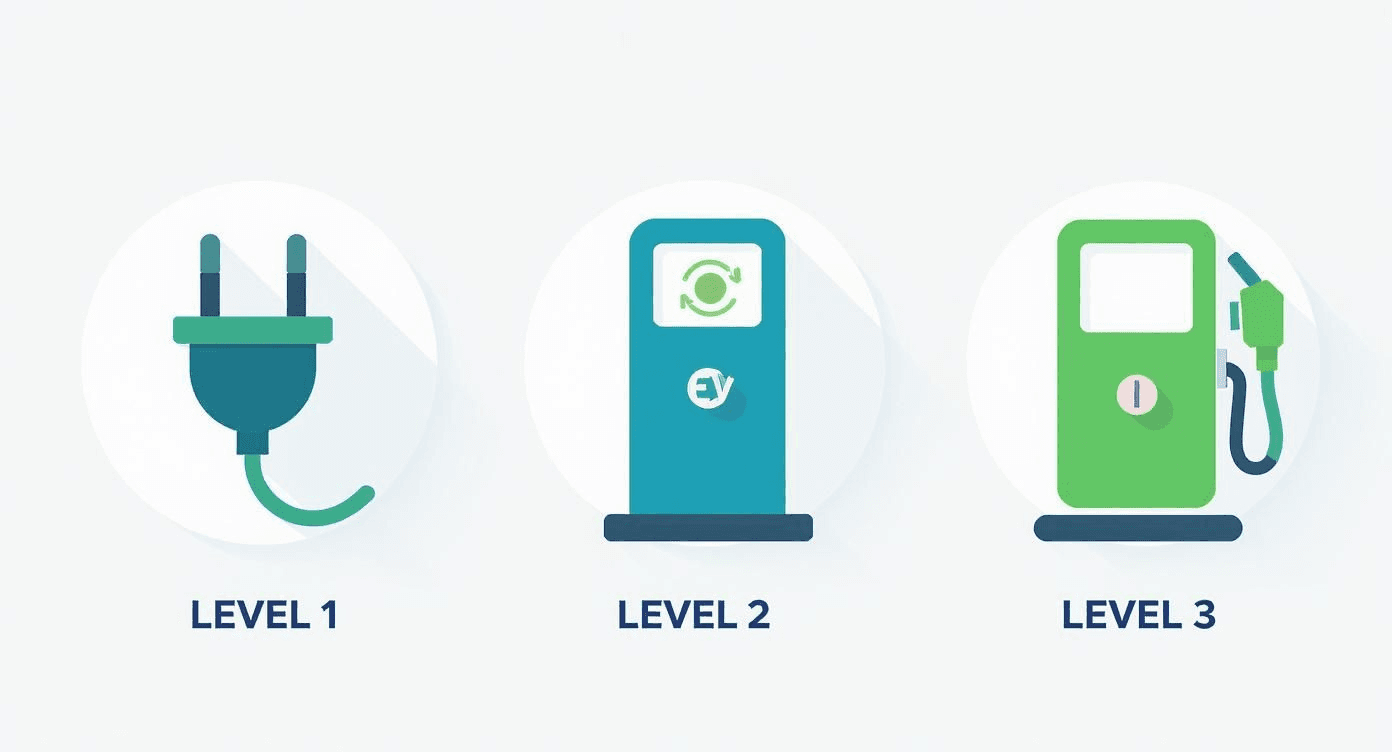
As you can see, Level 1 is just too slow for daily use, while Level 3 is a commercial-grade beast with power needs far beyond any home. Level 2 hits that perfect sweet spot of speed and affordability for most California homeowners.
Your Electrical Panel's Capacity
The single most critical factor in your installation is your electrical panel’s current capacity. Your panel is like a big power strip for your whole house; it only has so much juice to give. Adding a powerful Level 2 charger, which usually needs its own 40- or 50-amp circuit, puts a major new demand on that system.
If your home is a bit older or already running a lot of heavy-duty appliances (like an electric stove, dryer, and central A/C), your panel might be maxed out. Many homes built before the 1990s have 100-amp panels, which often just isn't enough to safely add a dedicated EV circuit.
An electrician might take one look and determine your panel can’t safely handle the new load. This is when they’ll recommend a main panel upgrade to a more modern 200-amp service—a significant, but absolutely essential, investment for safety.
This upgrade is the number one reason a quote comes in higher than expected, but it's a non-negotiable step to prevent overloaded circuits and serious fire hazards.
The Path of the Wiring
Beyond the panel itself, the physical route the wiring has to take from the panel to your charger plays a huge role in the final cost. A "straightforward" installation is one where the electrical panel is already in the garage, right next to where you want the charger mounted.
But many homes in Los Angeles and Ventura County have layouts that are a bit more complicated. Here’s what can add to the labor and material costs:
Distance: The longer the run, the more expensive copper wiring you'll need. A very long run can also cause a "voltage drop," which means the electrician might have to use even thicker, pricier wire to make sure your charger gets enough power.
Obstacles: Does the wire need to pass through finished drywall? That means cutting into the wall, running the wire, and then patching and painting everything afterward.
Drilling: Sometimes, electricians have to drill through thick concrete foundation walls or heavy wood beams to create a path for the wiring. That takes more time and specialized tools than just running it along an unfinished wall.
Trenching: If your garage is detached from your house, the electrician has to dig a trench to bury the electrical line underground. This adds a lot of labor to the job.
The Need for a Panel Upgrade
If an electrician says your current panel can't support the new charger, an upgrade is the only safe path forward. This isn't just swapping out a box; it's a major electrical project that gets your home ready for today’s power demands and whatever comes next.
Upgrading your panel involves a few key steps:
Permitting: A separate permit is required for a panel upgrade.
Coordination: Your electrician will have to work with the local utility company to temporarily shut off power to your home.
Installation: The old panel gets removed, and a new, higher-capacity one is installed with all-new circuit breakers.
Inspection: A city or county inspector has to sign off on the work to make sure it meets all current electrical codes.
While this definitely adds to the electric vehicle charger installation cost, it's a massive upgrade for your home's safety and capacity. You can get a deeper dive into this by exploring the cost to install an electrical panel in our detailed guide.
Ready to get a clear, personalized quote for your EV charger installation? The licensed electricians at RC Generators and Electric specialize in assessing your home's unique needs, from panel capacity to wiring routes, ensuring a safe and efficient setup. Contact us today for a professional consultation!
Navigating California Permits and Labor Rates
When you start adding up the electric vehicle charger installation cost, it’s easy to focus on the charger itself. But two other critical pieces of the puzzle often get overlooked until the final quote arrives: the permits and the people. These aren’t just extra fees tacked on at the end; they’re essential for a safe, legal, and reliable setup. Getting a handle on these costs is key to seeing the full picture.
First up, let's talk permits. A Level 2 charger needs a dedicated 240V circuit, which is a serious electrical project. Because of that, nearly every city and county in California, from Los Angeles to the Bay Area, requires a permit for the work. It might feel like red tape, but it’s actually a crucial safety net for your home.
The permit process ensures a licensed pro is doing the job and that an independent inspector will verify it meets the strict standards of the National Electrical Code (NEC) and local building codes. This protects you from fire hazards, guarantees the work is done right, and keeps your homeowner's insurance happy.
Why Professional Labor is a Smart Investment
The second major part of the cost is the labor. When you hire a licensed electrician, you’re not just paying for a few hours of their time. You're investing in their years of training, their deep knowledge of electrical systems, their insurance, and their commitment to getting the job done safely.
It can be tempting to save a few hundred bucks by hiring an unlicensed handyman, but this is one of the riskiest shortcuts a homeowner can take. An improper installation can lead to a world of headaches:
Failed Inspections: If the work doesn’t pass the city’s inspection, you'll have to pay a licensed electrician to come in, remove the incorrect work, and do it all over again. That's double the cost and double the hassle.
Serious Safety Risks: Overloaded circuits, improper grounding, and using the wrong size wires are all serious fire hazards that can put your home—and your expensive new EV—at risk.
Voided Warranties: Both your car and your charger come with warranties that can be voided if they’re damaged by a non-compliant installation.
A licensed electrician knows exactly how to calculate your home's electrical needs, pick the right circuit breaker, and make sure every single connection is rock-solid.
Understanding Electrician Rates Across California
Labor costs for a licensed electrician will change depending on where you are in California. As you’d expect, rates in high-cost areas like the Bay Area or Los Angeles are generally higher than in the Central Valley. On average, you can expect to pay between $100 to $200 per hour for a qualified electrician.
A standard installation usually takes between three and seven hours, depending on how complex the job is. That time covers everything from the initial assessment and planning to running the wiring, mounting the charger, and the final testing. If your project is more involved—say, you need a new subpanel or extensive trenching—the labor time will naturally be higher.
Finding a trustworthy, certified professional is non-negotiable for your peace of mind. For homeowners in Southern California, the certified pros at RC Generators and Electric provide top-tier electrical services in Los Angeles, specializing in safe and compliant EV charger installations.
Ultimately, paying for professional labor and permits is an investment in safety, reliability, and the long-term value of your home. It's what ensures your charger will work flawlessly for years to come without ever putting your electrical system at risk.
Saving Money on Your EV Charger Installation
So you've figured out the permits and labor involved. The next big question is pretty obvious: how can you get that final electric vehicle charger installation cost down? The good news is, with a little planning, you can significantly reduce your out-of-pocket expenses.
The trick is to combine government incentives with a few smart, practical decisions about the installation itself. Many California homeowners are surprised to find they can save hundreds, or even thousands, of dollars just by tapping into the resources already available to them.
Tapping into Rebates and Tax Credits
One of the easiest ways to save is through federal, state, and local incentives. These programs are specifically designed to make home charging more affordable and encourage more people to switch to EVs.
On the federal level, you might be eligible for a tax credit covering 30% of the cost of your charger and the installation. That’s a huge chunk of savings right off the top.
Keep in mind that tax laws and incentive programs can change. It's always a good idea to check official government and utility websites for the most current information before you buy anything.
Beyond the federal help, California has its own savings opportunities. Many local utility companies, from Southern California Edison to PG&E, offer rebates when you buy and install a Level 2 charger. These programs can put a few hundred dollars right back in your pocket.
California-Specific Programs to Explore
Living in California gives you access to some of the best EV incentives in the country. To see what’s available in your neighborhood, a great first step is to visit the websites for your local utility provider and the California Air Resources Board (CARB). They keep updated lists of active rebates.
Here are a few types of programs you should be looking for:
Utility Rebates: These are straightforward cash-back offers from your electricity provider for installing a qualified Level 2 charger.
Time-of-Use (TOU) Rate Plans: Special electricity rates that can make charging your EV overnight much, much cheaper.
Local Air District Grants: Some regional air quality districts offer their own grants to help promote clean transportation.
Applying is usually a simple online process, but always read the fine print. Some programs require you to use specific charger models or work with a certified installer.
Practical Tips for a Cost-Effective Installation
Incentives are fantastic, but you can also save money just by being strategic about the installation itself.
One of the simplest and most effective ways to keep costs down is to install your charger as close to your main electrical panel as possible. The farther away it is, the more expensive copper wiring and conduit you'll need, and the more labor it will take to run the line. A short, direct route is always the most budget-friendly choice.
Bundling Services for Greater Value
If you’re already planning other electrical work for your home, bundling projects can be a really savvy move. Many homeowners discover their electrical panel is almost maxed out and will need an upgrade soon anyway. Combining an EV charger installation with a panel check or a full main panel upgrade is often cheaper than doing them as two separate jobs.
This approach saves you from paying for two separate service calls and two sets of permit fees down the road. Better yet, if you've been thinking about a solution for power outages, bundling your EV charger project with a home backup generator installation provides incredible value and peace of mind. A trusted contractor like RC Generators and Electric specializes in these kinds of comprehensive projects, making sure all the work is done right, all at once.
Ready to explore your options and get a clear, all-inclusive quote? Contact RC Generators and Electric today to discuss your EV charger installation and see how bundling services can deliver the best value for your Southern California home.
Why Professional Installation Is Your Best Investment
When you're looking at the total electric vehicle charger installation cost, it’s natural to look for places to trim the budget. A DIY approach might seem like a clever way to save a few hundred bucks, but hold on before you head down that road.
Hiring a licensed, professional electrician isn't just another line item—it's the single most important investment you'll make in this entire process. We're talking about protecting your home, your brand-new EV, and your family.
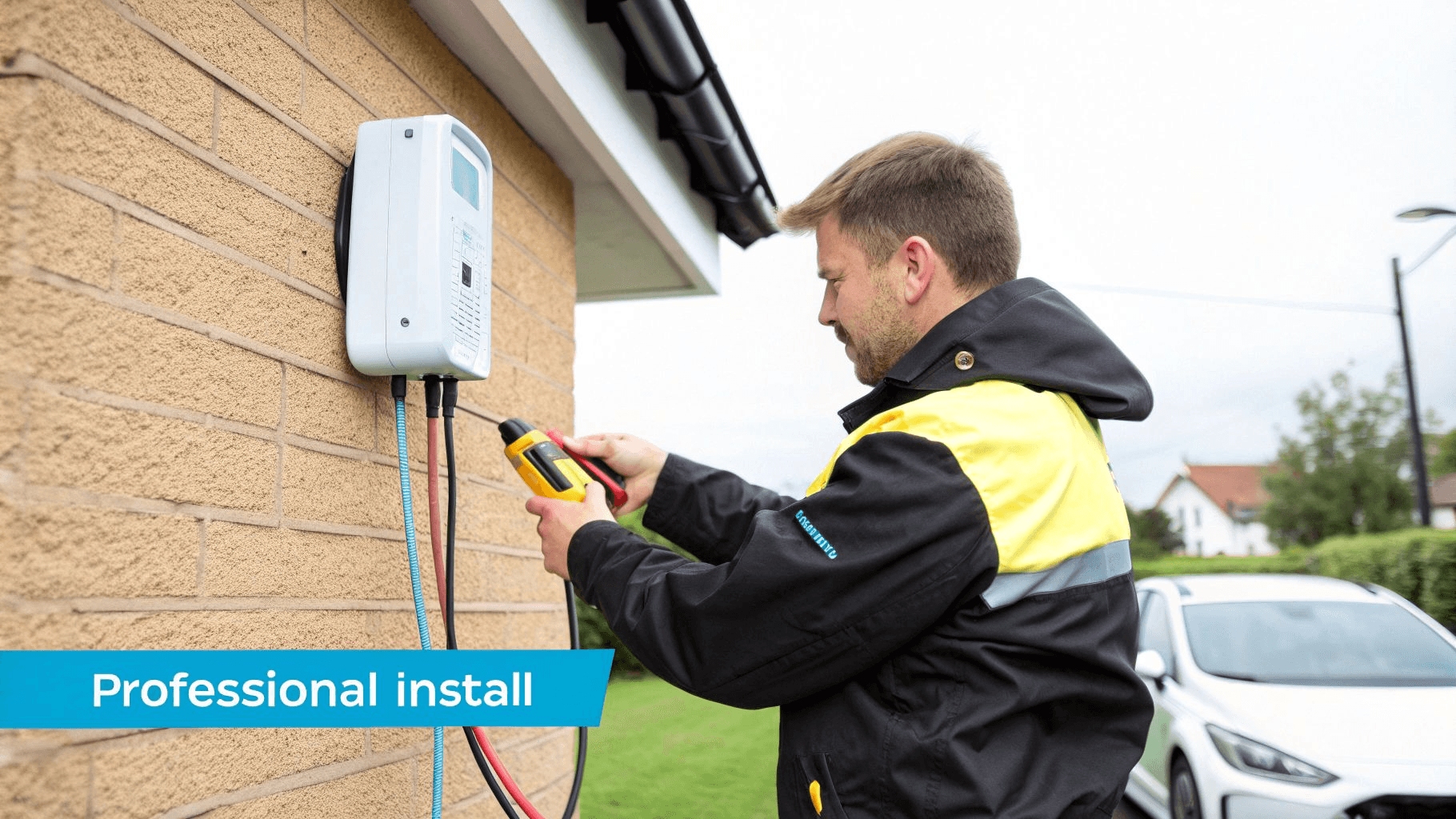
A pro ensures every part of the job meets the strict electrical codes we have here in California. This isn't just about red tape; it's about eliminating very real dangers like overloaded circuits and potential fire hazards.
Safety and Compliance You Can Count On
A certified electrician brings a lot more to the table than just connecting wires. They start with a crucial load calculation—an assessment to confirm your home’s electrical panel can safely handle the new, sustained demand from an EV charger. Skipping this step is a recipe for dangerous system overloads.
A professional installation is your best defense against electrical issues and is a requirement for keeping your homeowner's insurance policy valid. An unpermitted, DIY job could give your insurance provider grounds to deny a claim in the event of an electrical fire.
Plus, a licensed professional in California knows exactly how to navigate the local permitting and inspection maze. This guarantees your installation is not only safe but also fully documented and signed off on by your city or county.
Securing Long-Term Reliability
At the end of the day, professional installation delivers a peace of mind that a DIY job simply can't offer. You can plug in your EV every night with total confidence, knowing the work was done right, the circuit is properly sized, and all the safety measures are locked in place.
This reliability also protects the sensitive electronics inside your EV and ensures your charger runs efficiently for years to come. It shifts the initial cost from being just an expense into a lasting investment in your home's safety and modern functionality.
Ready to ensure your EV charger is installed with the highest standards of safety and expertise? Contact the certified electricians at RC Generators and Electric today for a professional consultation and a code-compliant installation in the Los Angeles and Ventura County areas.
Common Questions About EV Charger Costs
As you get closer to finalizing your EV charger installation, a few questions almost always pop up. Let's tackle them head-on so you can move forward with confidence, knowing all your bases are covered.
Do I Need a Special Charger for My Tesla?
This is easily one of the most common questions from new Tesla owners, and for good reason. While Teslas have their own unique connector, you don’t automatically have to buy a Tesla-branded Wall Connector.
Most universal Level 2 chargers use the standard J1772 plug. You can use one of these with a simple adapter—in fact, Tesla usually includes one with your vehicle. It works perfectly.
That said, a dedicated Tesla Wall Connector can offer a more seamless experience and sometimes even faster charging speeds, depending on your car’s specific hardware. A licensed electrician can install either one, making sure it’s a perfect match for your home’s electrical system.
How Much Will My Electricity Bill Go Up?
It's going to go up, but probably not as much as you're picturing. The exact amount really comes down to your local utility rates here in California and, of course, how much you drive.
Here's a quick way to estimate your new monthly cost:
(Total Miles Driven / Vehicle Efficiency) x Electricity Rate.For example, let's say you drive 1,000 miles a month in a car that gets 3.5 miles per kWh. If your electricity costs $0.30/kWh, you’d be looking at an increase of about $85 per month. For most people, that’s a fraction of what they were spending on gas.
Can I Install a Charger in My Condo or Apartment?
Yes, in most cases, you can. California has "right-to-charge" laws designed to prevent landlords or HOAs from putting up unreasonable roadblocks when you request to install an EV charger in your designated parking spot.
You'll almost always be responsible for the full installation cost and will need to follow a proper approval process, but the law is definitely on your side to make it happen.
Ready to get a precise, no-surprise quote for your home? The certified electricians at RC Generators and Electric specialize in safe, code-compliant EV charger installations, including Tesla Wall Connectors. We can assess your home's specific needs and give you a clear path forward.
Contact us today for a professional consultation and take the final step toward convenient home charging.