
What size whole-home generator does your Los Angeles or Ventura home really need? A real load-calculation method from an authorized Cummins and Generac dealer.
Date
Jun 5, 2026
Author
Gabriel Camarillo
Read
8 min
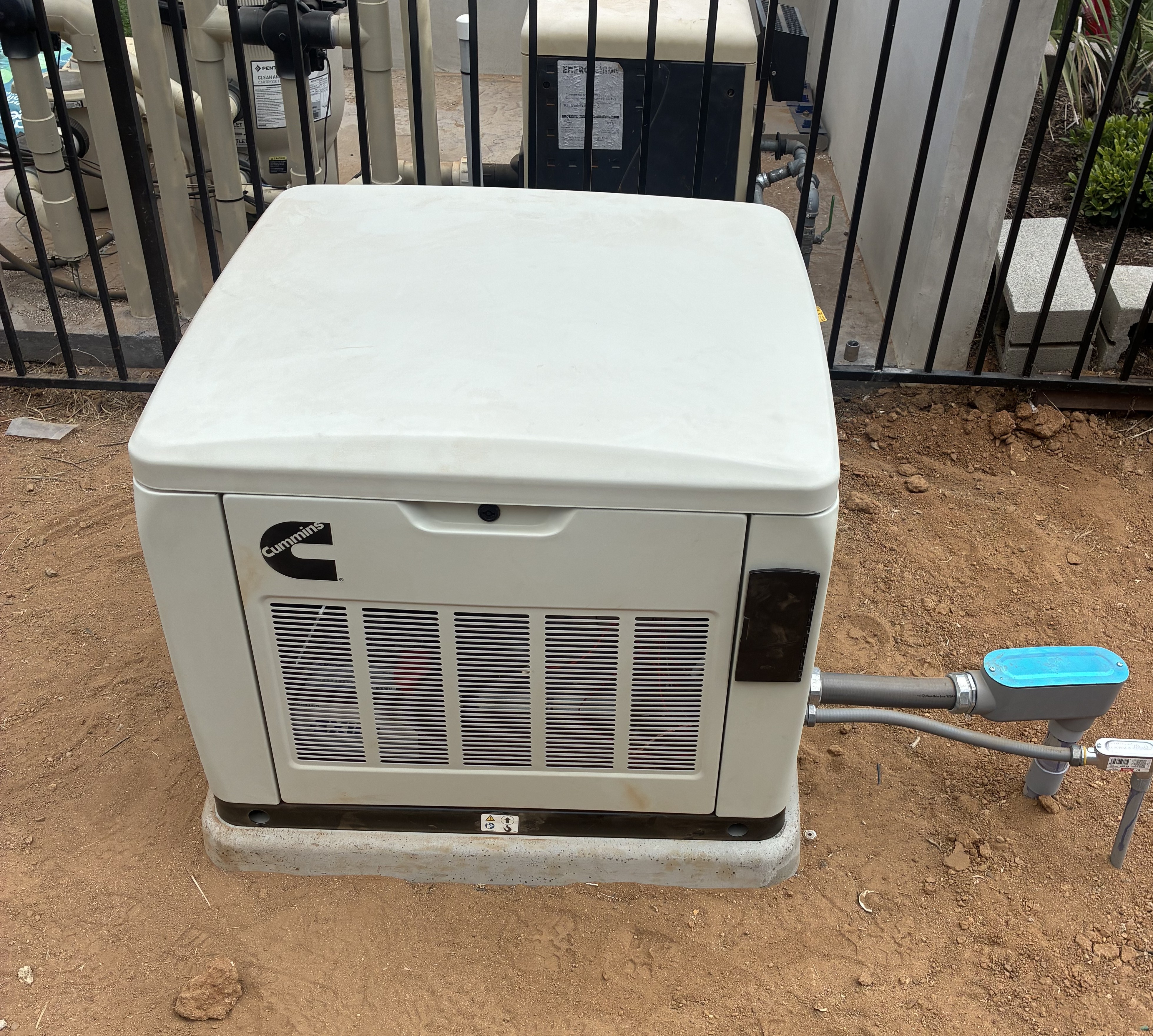
The most common question we get on the phone is some version of "what size generator do I need?" As an authorized Cummins dealer and a full-service Generac dealer, we install both lines, so the sizing conversation never starts with what we have in stock — it starts with what your home actually pulls.
This guide walks through the same load calculation we do on every site visit, plus brand-by-brand recommendations at each size.
The 30-Second Answer
For a typical Los Angeles or Ventura home with central AC, modern appliances, and a single electrical panel, you'll land in one of four sizes:
1,500 to 2,500 sq ft, single AC: 13kW to 17kW. Cummins RS13 or Generac 14kW Guardian.
2,500 to 5,000 sq ft, central AC, modern kitchen: 20kW to 22kW. Cummins QuietConnect RS20 or Generac 22kW Guardian — the most common size we install.
5,000 to 8,000 sq ft, two AC compressors, pool, EV charger: 24kW to 32kW. Cummins 26kW or Generac 26kW Guardian.
8,000+ sq ft estate, 400A service, well pumps, multiple HVAC zones: 36kW to 48kW. Cummins 36kW commercial-grade or Generac Protector 36kW.
That's the shortcut. Doing it right takes a real load calculation, not a guess from a square-footage chart on a manufacturer website.
Why Sizing Matters More Than You Think
An undersized generator is worse than no generator. When the grid drops and your system can't handle the actual load, the generator overloads, throws a fault code, and shuts off — leaving you in the dark anyway. Worse, repeated overloads damage the windings on the alternator. You bought a $20,000 system and it can't handle a Tuesday in August when both AC units are running.
Oversizing has its own cost. A 48kW system at a 4,000 sq ft house wastes about $8,000 in equipment, takes a larger pad, costs more to maintain, and burns more fuel per hour of runtime. You also need a larger natural gas line, which can add $2,000 to $4,000 to the install.
The sweet spot is 120 to 130 percent of your peak running load. That gives you headroom for surge loads (an AC compressor starting) without leaving capacity sitting unused.
How We Actually Calculate It
A real load calculation looks at three numbers for every major circuit in your home:
Running watts — what the appliance pulls during normal operation.
Surge watts — what it pulls at startup (typically 2 to 3 times running watts for anything with a motor).
Coincident load — what's actually running at the same time during a power outage.
We walk every panel with a clamp meter, log the breaker amperages, and ask about lifestyle: do you run the pool pump at night, do you have a workshop, do both AC zones run simultaneously, will an EV be charging during outages.
Here's a real example from a Calabasas project this spring.
Real Sizing Example: 3,800 sq ft Calabasas Home
The homeowner asked for a quote on a 14kW Generac after seeing one at a neighbor's house. Here's what we found during the load walk:
One 5-ton central AC compressor (4,500 running watts, 13,500 surge watts)
Furnace blower (1,200 watts)
Refrigerator + chest freezer (1,400 watts combined)
Kitchen: range hood, microwave, dishwasher (peak coincident around 3,000 watts)
Pool pump (1,800 watts running, 5,400 watts surge)
Lighting, computers, TVs, modems (estimated 1,500 watts)
One Tesla EV charging at 32A (7,680 watts)
Peak running load with the EV plugged in and the AC cycling: about 17,500 watts steady, with a 21,000-watt momentary surge when the AC compressor kicks on.
A 14kW Generac would have tripped the moment the AC engaged on a hot day. We sized up to a 22kW unit — in this case the homeowner chose the Cummins QuietConnect RS22 for the quieter operation since the pad sits about 12 feet from the master bedroom window. The Generac 22kW Guardian would have done the job too at a lower price point.
Special Considerations for LA and Ventura Homes
A few local factors push our region toward larger systems than national averages.
Multiple AC zones. Hillside homes in Bel Air, Hidden Hills, and the Palisades commonly have two or even three separate AC compressors for different floors or wings. Each one needs surge headroom. A two-compressor home almost always needs 24kW or more.
Pools and spas. A single-speed pool pump is 1.5 to 2 kW running and 4 to 5 kW on surge. Variable-speed pumps are kinder but still draw real power. Spa heaters can add another 5 kW.
EV charging. A Tesla Wall Connector at 48A pulls 11.5 kW. Many homeowners want to keep EV charging available during outages — which alone forces you up a size tier. We can also configure the system to load-shed the EV automatically during peak demand, which keeps a smaller generator viable.
Well pumps. Common in Ventura County and parts of the Santa Monica Mountains. A standard 1.5 HP well pump pulls 2 kW running and 6 to 7 kW on surge. Always factor it in.
Coastal homes. Malibu and Pacific Palisades installs often need higher-grade enclosures because salt air shortens lifespan on standard enclosures by 20 to 30 percent. Both Cummins and Generac offer corrosion-resistant options for coastal installations.
When You Can Get Away With Smaller
You don't have to back up the whole house. We install plenty of partial-home (essentials-only) systems that pair a 13kW or 17kW generator with a smart transfer switch that powers a sub-panel of critical circuits only. Typical essentials-only setups cover: refrigerator, freezer, furnace blower, well pump, garage door, internet/Wi-Fi, kitchen receptacles, and a few lights. AC and EV charging stay off during the outage.
This is a great choice for homeowners who want backup peace of mind without the capital outlay of a whole-home system. Cost range: $9,500 to $13,500 all-in in our market.
Pairing With Battery Backup
For many of our customers, the smartest move isn't just a bigger generator — it's a layered system. A Franklin Home Power or Tesla Powerwall battery handles short outages silently, runs the home off solar during the day, and only hands off to the generator when the outage stretches past battery capacity. We design and install both layers.
A common pairing for a 4,000 sq ft Calabasas or Malibu home: a Cummins QuietConnect 20kW generator plus a Franklin Home Power aPower 2 battery, or a Generac 22kW Guardian plus two Tesla Powerwall 3 units. Total installed cost typically lands $32,000 to $52,000.
The Brand and Model Recommendations We Actually Make
For each size band, here's what we install most and why.
13–17kW — Cummins RS13 or RS17 for the quieter enclosure and the commercial-grade engine. Generac 14kW Guardian for value. Both are excellent partial-home picks.
20–22kW — Cummins QuietConnect RS20 or RS22 is our most-recommended whole-home unit for homes within earshot of bedrooms. Generac 22kW Guardian (model 7043) is the value pick and the most common system in the broader California market — sharpest pricing, vast parts network.
24–32kW — Cummins 26kW for noise-sensitive homes and HOA-restricted properties. Generac 26kW Guardian for value. Both handle two-compressor homes with pool and EV charging easily.
36–48kW — Cummins QSJ36 or QSJ48 commercial-grade systems. Generac Protector 36kW or 48kW liquid-cooled. These engines handle the load profile of 8,000+ sq ft homes, multi-zone HVAC, well pumps, and large pool/spa equipment.
Common Mistakes Homeowners Make
Sizing off square footage alone. Manufacturer sizing tools use square footage as a shortcut, but they don't know how many AC compressors you have or whether you own a Tesla. Always do a real load walk.
Forgetting the EV charger. Adding a Tesla Wall Connector after you install a generator can blow past the system's capacity. Either size up at install, or have us configure load-shedding.
Buying the same system the neighbor bought. Your neighbor's 3,000 sq ft home with one AC zone is not the same load profile as your 3,000 sq ft home with two zones and a pool.
Going too big "just to be safe." A 36kW system at a 3,500 sq ft house wastes equipment cost, requires a bigger gas line and pad, and burns more fuel per hour. Right-sized beats oversized every time.
Ready for a Real Spec?
If you want a real sizing recommendation for your home — not a square-footage guess — we offer free on-site assessments within 25 miles of our LA base. We'll walk every circuit, factor in your actual lifestyle, and quote the right Cummins or Generac system for what you actually need.
Call (818) 606-8651 or request a quote online. We'll get you spec'd in 30 minutes and you'll know exactly what you need.
RC Generators & Electric is a CSLB-licensed (#1105336) electrical contractor based in the greater Los Angeles area. We're an authorized Cummins dealer and a full-service Generac dealer — sales, installation, and service for both lines. We're also authorized installers for Franklin Home Power and Tesla Powerwall battery backup systems. Specialists in residential and commercial standby generator installation with 80+ generator projects completed and 1,000+ electrical projects overall, across the LA, Malibu, and Ventura County markets. Free on-site assessment within 25 miles. (818) 606-8651.