
Learn how to calculate electrical load, and size your home generator accurately for reliable backup power.
Date
Dec 16, 2025
Author
RC Admin
Read
5 min
Before you even think about picking out a Generac home backup generator, there’s one number you absolutely have to know: your home’s electrical load.
Think of it as the total amount of power your home needs to keep everything running, from the big stuff like your air conditioner down to the Wi-Fi router you can't live without. Getting this number wrong isn't just a small oops—it’s a mistake that leads to major headaches, especially when the power goes out during a California wildfire or PSPS event.
Why Guessing Your Electrical Load Is a Costly Mistake
So, what happens if you just guess? Or worse, trust a generic online calculator? It almost always ends in one of two expensive scenarios.
On one hand, you could underestimate your needs. This leaves you with an undersized generator that constantly overloads and shuts down during a California Public Safety Power Shutoff (PSPS). You'll be right back in the dark when you need power the most.
On the other hand, you could overestimate. Now you’ve bought an oversized generator that cost thousands more than it should have upfront. On top of that, it will burn through extra fuel for its entire life. Neither outcome is good.
The Building Blocks of Power
To get this right, you first need to understand a few basics. Don't worry, we'll skip the dense technical jargon. Just imagine electricity flowing through your home's wires like water in a pipe.
Volts (Voltage): This is the pressure pushing the electricity. Most standard outlets in California homes are 120 volts. The big appliances, like your dryer or central AC, need more push, so they use 240 volts.
Amps (Amperage): This is the volume or flow rate of the electricity. It tells you how much power is actually moving through the wire at any given moment.
Watts (Wattage): This is the total power an appliance uses. It’s the most important number for our calculation, and you find it by multiplying volts by amps (Watts = Volts x Amps).
A precise electrical load calculation is the foundation for a safe, reliable backup power system. This knowledge empowers you to make a smart investment for your family's security and avoid the pitfalls of an improperly sized generator.
Beyond Simple Addition
Knowing these terms is just the first step. A small LED light bulb might only sip 10 watts, but a central air conditioner can guzzle over 5,000 watts when it kicks on. Your home’s total load is basically the sum of everything you want to power at the same time during an outage.
But here’s where it gets tricky—it’s not just about adding up the wattage of every single device you own. A real, professional calculation considers which appliances run constantly versus which ones cycle on and off. This distinction is what separates a good calculation from a bad one.
Getting this right is critical for sizing a Generac generator or a solar-powered backup system that can handle your real-world usage without skipping a beat. It ensures your system is both effective and efficient, providing reliable power during fires, storms, and whatever else comes our way.
Ready to get your home prepared? For a professional assessment of your home's specific needs, contact RC Generators and Electric today. Our licensed electricians provide accurate load calculations to ensure your Generac generator or home backup system is a perfect fit.
Tallying Up Your Home's Power Needs, Room by Room
Alright, let's get down to the brass tacks of figuring out your home's electrical load. This part is all about rolling up your sleeves and creating a detailed inventory. We’re going to walk through your house, room by room, and make a complete list of every single thing you’d want to keep running during an outage.
This isn’t just a guessing game—it's a fact-finding mission that will become the blueprint for your entire backup power strategy. So, grab a notepad or fire up a spreadsheet, and let's get started.
Hunting for the Power Numbers
For every item on your list, you need to find its power consumption, which is measured in watts (W). Most devices have a small sticker or metal plate on them—this is the nameplate. You can usually find it on the back, bottom, or near the power cord.
Think of this nameplate as a treasure map. It lists the manufacturer, model number, and most importantly, the electrical specs. You’re looking for the wattage. If you see it listed directly, perfect! Jot that number down.
Sometimes, though, the nameplate only gives you volts (V) and amps (A). No sweat. You can find the wattage with a simple formula:
Watts = Volts x Amps
So, if you find a label that says 120V and 2.5A, the math is just 120 x 2.5 = 300 watts. This little bit of multiplication is the key to getting your power needs cataloged accurately.
The Room-by-Room Breakdown
Start in one area, say the kitchen, and be methodical. Don't just list the big-ticket items; think about every single thing you plug in.
Kitchen: Refrigerator, freezer, microwave, coffee maker, toaster, dishwasher, and garbage disposal.
Living Room: Your TV, sound system, internet modem and router, lamps, and any gaming consoles.
Bedrooms: Lights, ceiling fans, phone chargers, and critical medical equipment (like a CPAP machine).
Utility Areas: Washing machine, electric dryer, well pump, sump pump, and that second freezer you have in the garage.
It’s surprisingly easy to forget items you don't use every day but are absolutely essential during an emergency. Building a thorough list is the single most important step in understanding what you truly need. For a more structured approach, you can reference our handy home energy audit checklist to make sure nothing gets missed.
Don't Overlook the "Hidden" Loads
Some of the biggest power hogs in your home are the ones we tend to forget because they’re built right in. These are often the appliances that separate the need for a basic backup from a whole-home Generac standby system.
Remember to account for "phantom loads"—those sneaky devices that draw power even when they're turned off, like your TV or microwave clock. While small on their own, they can add up to 5-10% of your total household electricity use.
Key systems to add to your list include:
Central Air Conditioning/Heating: This is frequently the single largest load in a California home.
Well Pump: If you're not on city water, you need power just to get water out of the tap.
Sump Pump: Absolutely critical for preventing a flooded basement during heavy rains.
EV Charger: A Level 2 EV charger is a massive continuous load, often pulling over 7,000 watts.
Medical Devices: Any life-sustaining equipment must be at the top of the priority list.
Quick Reference for Common Appliances
Can't find a nameplate on an older appliance? You can use a reference chart to get a pretty good estimate. While the nameplate is always the most accurate source, the table below provides typical wattage values for common household items. Keep in mind that "Starting Watts" refers to that extra jolt of power motor-driven appliances need just to kick on.
Typical Wattage of Common Household Appliances
Use this quick reference guide to estimate the power consumption of everyday items in your home when you can't find the nameplate.
Appliance Category | Item | Estimated Running Watts | Estimated Starting Watts |
|---|---|---|---|
Kitchen | Refrigerator/Freezer | 700 W | 2,200 W |
Microwave | 1,000 W | N/A | |
Coffee Maker | 900 W | N/A | |
Comfort | Central AC (3-ton) | 3,500 W | 5,000-7,000 W |
Window AC Unit | 1,200 W | 1,800 W | |
Furnace Fan (Gas/Oil) | 750 W | 1,500 W | |
Utility | Washing Machine | 1,150 W | 2,250 W |
Electric Dryer | 5,400 W | 6,750 W | |
Well Pump (1/2 HP) | 1,000 W | 2,000 W | |
Electronics | Television (LED) | 150 W | N/A |
Wi-Fi Router & Modem | 15 W | N/A |
Once you have this complete list compiled, you’ve got the raw data you need for the next step: refining this total into a realistic electrical load calculation.
This detailed inventory might feel a bit tedious, but it’s the only way to ensure the Generac generator or home battery system you choose is perfectly sized for your family's safety and comfort.
Calculating Your True Power Needs with Demand Factors
If you’ve ever tried adding up the wattage of every single appliance and lightbulb in your home, you probably ended up with a shockingly high number. Don't panic—that figure isn't your actual electrical load. The truth is, you never use everything all at once. It’s not like you’re brewing coffee, running the dishwasher, and blasting the AC at the exact same moment.
This is where a crucial concept called demand factors comes into play. Instead of sizing an electrical system for a theoretical, worst-case scenario that will never happen, electricians use these factors to land on a realistic, practical load. This ensures your system is powerful enough for your real-world needs without being oversized and unnecessarily expensive.
So, How Do Demand Factors Work?
Think of demand factors as smart shortcuts that help estimate realistic power usage. They are based on decades of real-world data about how people actually use electricity. It’s a much smarter way to calculate your load because it accounts for the diversity of use in a typical home.
Your home's lighting is a perfect example. It's highly unlikely that every single light in your house will be on simultaneously, so electricians apply a demand factor to the total lighting load to get a more realistic number.
This professional approach avoids oversizing your system, which saves you money on the initial installation of a Generac generator and on your fuel costs for years to come. It’s all about building an efficient system, not an excessive one.
This infographic gives you a simple look at the first step—gathering the raw data for these calculations.
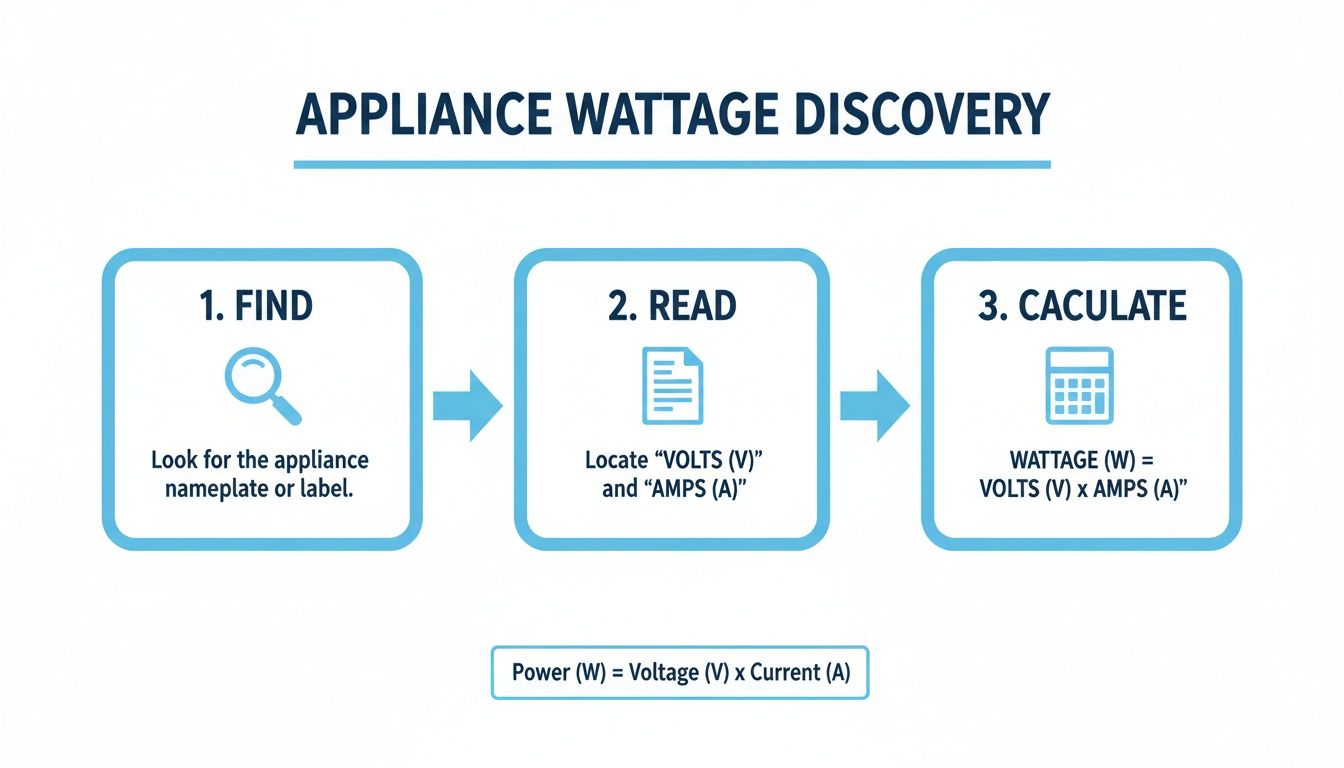
Once you've found, read, and calculated the wattage for each device, those are the raw numbers an electrician will refine using demand factors to get a final, accurate load.
Continuous vs. Non-Continuous Loads
Another critical piece of the puzzle is knowing the difference between devices that run for short bursts and those that stay on for hours.
Non-Continuous Loads: These are the things you use for brief periods. Think microwaves, toasters, or garbage disposals. They turn on, do their job, and shut off pretty quickly.
Continuous Loads: This is any appliance or system that can run for three hours or more at its maximum output. For most homes in California, the big ones are the air conditioner, an electric furnace, and EV chargers.
This distinction is absolutely vital for safety. Continuous loads generate a lot more heat in your wiring over time. To account for this, electricians are required to add a 125% safety margin just for these loads.
So, if your central air conditioner is rated at 4,000 watts, a professional calculation will treat it as a 5,000-watt load (4,000 x 1.25). This buffer prevents circuits from overheating and ensures they can safely handle that sustained demand.
Putting It All Together
At its core, an electrical load calculation starts with the basic formula: Load = Voltage × Current. But real-world calculations performed by professionals get more nuanced.
For example, take a home with a 16,500W total lighting load. An electrician would count the first 3,000W at 100%, but everything above that is only counted at 35%. So the math looks like this:
(3,000 × 1.0) + (13,500 × 0.35) = 7,725W
That 7,725W is the demand load—a far cry from the original 16,500W! If that load includes a continuous system like HVAC, we'd add another 25% safety margin, bringing it to around 9,656W.
Of course, you have to account for all the major systems in your home, which is why a precise HVAC load calculation is so important. This ensures your biggest energy hogs are factored in correctly with the proper safety margins.
This professional methodology is exactly why a DIY calculation from an online tool often falls short. It just can’t account for the unique blend of loads in your home or apply the correct demand factors.
For a reliable and safe backup power solution—whether it's a Generac generator or a home battery system—a professional load analysis is the only way to go. It guarantees your system is sized perfectly for your lifestyle, ensuring safety, efficiency, and peace of mind.
Sizing Your Generac Generator for California Realities
This is where the rubber meets the road. Let’s take everything we’ve talked about and apply it to a real-world scenario: choosing the right Generac home standby generator to get you through a California power outage.
To make it practical, we'll walk through two common setups for a typical home here. First, we’ll look at backing up just the essentials. Then, we'll scale things up to a whole-home solution for total peace of mind.
Scenario 1: The Essentials-Only Backup
This is a popular approach for homeowners who want to cover their bases—safety, security, and basic comfort—without powering every last gadget in the house. The goal here is to keep the critical systems online, like your fridge, a few lights, the internet, and maybe a small window AC unit for a single room.
Here’s what a sample "essentials-only" calculation might look like:
Refrigerator: 700 running watts
Key Lights (5 LED bulbs): 50 running watts (10W x 5)
Internet Modem & Router: 15 running watts
Phone Chargers (2): 20 running watts (10W x 2)
Small Window AC Unit: 1,200 running watts
That brings our total running load to 1,985 watts. But hold on, we’re not ready to pick a generator just yet.
The Critical Role of Starting Wattage
The single biggest hurdle in sizing a generator is what's called starting wattage or "surge wattage." Appliances with motors—think refrigerators, pumps, and air conditioners—need a massive jolt of power just to kick on. This initial surge can be 3 to 5 times their normal running wattage, lasting only a few seconds.
Let's factor that surge into our essentials list:
Refrigerator Starting Wattage: ~2,200 watts
Window AC Starting Wattage: ~1,800 watts
To keep from tripping the generator's breaker right at startup, you have to account for the single largest surge. We'll take the refrigerator's 2,200W surge and add it to the running watts of everything else (785W). That gives us a required starting capacity of 2,985 watts. A smaller Generac standby unit, like a 7.5kW or 10kW model, would handle this load beautifully, with plenty of headroom to spare.
Sizing your generator correctly by focusing on the starting wattage prevents you from overspending on a unit that’s way too big for your actual needs.
Scenario 2: The Whole-Home Comfort Solution
For a lot of us in California, especially during PSPS events or fire season, the goal isn't just to survive an outage—it's to live normally. That means powering everything: the central air, the electric dryer, the oven, and maybe even the EV charger.
Let’s build that whole-home calculation. We’ll start with our essentials from before and pile on the heavy hitters.
Previous Essentials Load: 1,985 running watts
Central AC (3-ton): 3,500 running watts
Electric Dryer: 5,400 running watts
Electric Oven: 2,150 running watts
Well Pump (if applicable): 1,000 running watts
Our new total running load has jumped to 14,035 watts, or roughly 14kW. Now, for the surge.
Highest Starting Wattage (Central AC): ~6,000 watts
Taking that huge 6,000W surge and adding it to the running total of all the other appliances gives us a peak demand over 16,535 watts. A calculation like this points us toward a more robust Generac model, probably in the 18kW to 24kW range, to ensure everything runs smoothly without a single flicker or compromise.
Modern Challenges: EV Chargers and Home Batteries
Today’s homes have power demands that simply didn’t exist ten years ago. If you add an EV charger or a home battery system, your load calculation changes dramatically.
A Level 2 EV charger is a massive, continuous load. It can pull 7,200 watts (7.2kW) or more for hours on end. That one device alone can double the electrical load of a smaller home. When sizing a generator, you have to factor that in with the 125% safety margin for continuous loads, meaning it adds a whopping 9,000 watts (9kW) to your calculation.
Home battery systems, including solar-powered setups, can work with a generator to provide instant, silent power and help manage peak loads. This might even allow you to install a slightly smaller generator. However, the system has to be designed by a pro to make sure the generator can recharge the battery while still powering your home.
This is exactly why figuring out how to properly size a home generator is more than just simple addition. It takes a professional eye to balance all these competing demands safely.
For a precise and safe calculation that considers your unique lifestyle—from EV charging to whole-home comfort—it’s time to call in the experts. Contact RC Generators and Electric today for a professional load analysis and a free estimate on the perfect Generac system for your California home.
Why a Professional Load Analysis Is Non-Negotiable
Getting a handle on wattage, demand factors, and starting loads is a great first step. It gives you the knowledge to have a smart conversation about your home’s backup power needs. But let’s be clear: a DIY calculation, no matter how detailed, has its limits. It should never be the final word when you're investing in your family's safety and comfort.
Bringing in a licensed California electrician for a professional load analysis isn’t just a good idea—it’s a critical, non-negotiable step. This isn't about just adding and multiplying on a worksheet. It’s a full-blown safety and system assessment to make sure your home is truly ready for anything.
Beyond the Numbers on a Notepad
A certified expert from RC Generators doesn't just tally up your appliances from a list. We get hands-on, evaluating your entire electrical system to answer the questions a simple calculator can't touch.
Is your electrical panel up to the task? An older or undersized panel might not have the capacity to handle a big new load like a Generac generator, especially if you're also thinking about an EV charger.
Is your wiring safe and up to code? We can spot existing issues that could become serious fire hazards when a new power source is connected.
What are the local permit requirements? Every county in California has its own rules for generator installations, particularly around placement, wiring, and even noise levels.
A proper load analysis is the only way to be certain your home's electrical system can safely meet its demands. Sometimes, it even uncovers the need for a guide to upgrading your electrical panel. This is all part of creating a complete, safe, and reliable energy solution for your home.
The Expertise Behind a Safe Installation
Professionals also use more sophisticated methods to get an accurate picture. They can fine-tune the final load based on how you actually live, a level of detail online tools always miss.
The real value of a professional analysis isn't just about getting the right-sized generator. It's the peace of mind that comes from knowing the entire system is integrated safely and will work flawlessly when you need it most.
Another key piece of the puzzle is the automatic transfer switch (ATS). This is the brain of your backup system, and its installation is a complex job that absolutely must be handled by a licensed electrician. The ATS is what safely disconnects your home from the grid during an outage and automatically fires up your Generac. An improper installation isn't just illegal; it's incredibly dangerous.
At RC Generators, we deliver more than just a piece of equipment. We provide a complete, code-compliant home energy solution you can count on when the lights go out. Our expertise in standby generator installation means we manage every single detail, from the first load calculation to the final permit sign-off.
Ready to take the next step toward energy independence? Contact RC Generators and Electric today for a free, on-site consultation and a professional load analysis tailored to your California home.
A Few More Questions We Hear All The Time
Even after you've run the numbers, it’s completely normal to have a few questions pop up. Here in California, we get a lot of calls from homeowners trying to figure out the best way to size a backup power system. Let's tackle some of the most common ones we hear.
Can I Just Use an Online Load Calculator?
Honestly, those online calculators are okay for a quick, back-of-the-napkin estimate, but that's about it. They just can't see the unique quirks of your home.
They almost always miss critical details like the massive startup wattage for motors (like your A/C), how to apply the right demand factors, or even if your existing electrical panel can handle the new load. For something as important as a whole-home Generac generator, you need a professional on-site. An online tool just can't deliver that kind of precision.
How Much Power Does an EV Charger Really Use?
An electric vehicle charger is a serious power draw. Think of it as a huge, continuous load on your home’s electrical system. A standard Level 2 charger can pull over 7,000 watts, which is often more than a central air conditioner running full blast.
Getting this number right in your load calculation is a huge deal. Because it's a continuous load, it needs a 125% safety buffer in the calculation. In many cases, adding one means you’ll need a bigger generator and possibly even a service panel upgrade to handle the extra demand safely.
Should I Back Up My Whole House or Just the Essentials?
This is probably the biggest decision homeowners face, and it really boils down to balancing your budget with your comfort.
Essentials-Only Backup: This is the more budget-friendly route. You'd power the critical stuff—your refrigerator, a few lights, and maybe your router. It requires a smaller Generac generator and the installation is simpler.
Whole-Home Backup: This is the "set it and forget it" option. The system is sized to power your entire electrical panel, so you can live your life as normal during an outage. No compromises. It provides ultimate peace of mind but demands a much more detailed professional load calculation to get it right.
Why Not Just Do the Calculation Myself?
Hiring a certified expert from RC Generators for this isn't just about getting the math right. It’s about ensuring the safety, reliability, and longevity of your entire backup power system.
An expert does more than just calculations. We conduct a complete safety inspection of your electrical system, ensure full compliance with California codes, and recommend a Generac generator or home battery system perfectly tailored to your needs.
Our team handles the professional installation of the generator and the automatic transfer switch, making sure your system kicks on automatically and safely when you need it. It's the only way to get real peace of mind, knowing your home is protected during fires, PSPS events, and any other emergency that comes your way.
Don't leave your family's safety to guesswork. For a precise load calculation and expert installation of a Generac generator or home battery backup system, trust the licensed professionals at RC Generators and Electric. We serve homeowners across California, ensuring your power stays on when you need it most.