
Calabasas sits in SCE's Tier 3 PSPS zone. Here's what 1,000+ installs taught us about whole-home backup — real costs, real timelines, real code.
Date
May 22, 2026
Author
Gabriel Camarillo
Read
7 min
PSPS Shutoffs in Calabasas: How to Prepare Your 91302 Home Before SCE Pulls the Switch Again
If you live in Calabasas, you already know the drill. The wind picks up off the Santa Monicas, your phone buzzes with an SCE alert at 6 a.m., and by lunchtime the refrigerator is silent, the alarm panel is beeping, and your home office is dead. Public Safety Power Shutoffs — PSPS — have been part of life in 91302 since 2019, and every fire season they get a little longer, a little less predictable, and a lot more expensive for homeowners who aren't ready.
This is the post I wish every Calabasas homeowner read before the first red flag warning of the season. It's based on 80+ whole-home generator installs across Los Angeles, Malibu, and Ventura County, and a stack of bid sheets, gas line calculations, and SCE outage logs from the past six years.
What a PSPS Actually Is (And Why Calabasas Gets Hit So Hard)
A PSPS is a deliberate de-energization. Southern California Edison cuts power to circuits running through high fire-risk areas when the National Weather Service flags Red Flag Warning conditions: low humidity, dry fuel, and sustained winds above roughly 30 mph with gusts higher. The point is to prevent a downed line from starting the next Woolsey or Saddleridge.
Calabasas sits squarely inside SCE's High Fire Threat District — most of 91302 is Tier 2 or Tier 3. The hillsides above Mulholland, the canyons running into Topanga and Las Virgenes, and the estates above Mureau Road all feed off overhead distribution lines that the utility will pull the plug on before the wind brings them down.
Six PSPS-related shutoffs hit Calabasas, Hidden Hills, and the Las Virgenes corridor between October 2019 and February 2026. Three of them lasted longer than 48 hours. One — the Santa Ana event in January 2025 — ran nearly five days for some pockets above Mountain View Estates. SCE's own reports show the average Calabasas-area PSPS is now 31 hours, and that number has been climbing every year as the utility expands its proactive shutoff footprint.
Here's the part most homeowners miss: a PSPS isn't restored when the wind dies. SCE has to physically inspect every mile of line in the de-energized footprint before re-energizing. That's helicopter patrols, ground crews, the works. So a 12-hour wind event easily turns into a 36-hour outage.
What 36 Hours Without Power Actually Costs You
Most Calabasas homes I bid on aren't running on a $5,000 panel. They have two HVAC zones, a wine fridge, a pool pump, a Tesla in the garage, a hardwired alarm and camera system, a water filtration setup, and — increasingly — solar with no battery, which means the panels go offline the moment the grid does. (Net-metering inverters shut down by federal anti-islanding rules. Solar without a battery is useless during a PSPS.)
Real numbers from the last fire season:
Spoiled refrigerator/freezer contents in a typical Hidden Hills kitchen: $400-$1,200
Restocking a stand-alone wine fridge after an extended outage: $2,000-$8,000 (yes, really)
Hotel + meals for a family of four during a 3-day shutoff: $1,800-$3,500
Lost remote-work hours for one professional: $1,500-$4,000
Pool equipment damage from algae bloom + restart: $600-$2,400
One Calabasas client called me after the January 2025 event with a $14,000 tally. They were ready to write a check that afternoon for a Generac 22kW Guardian.
The Four Backup Power Options for a Calabasas Home (Ranked)
There are essentially four ways to ride out a PSPS. Only one of them is really viable for a whole home in 91302.
Option 1: Portable generator + extension cords. Fine for a fridge and a phone charger. Useless for HVAC, a well pump, or a 200A service panel. A 7,000W portable from Home Depot runs about $900 and won't start your 4-ton A/C compressor. Skip it for any real estate above 2,500 square feet.
Option 2: Battery only (Tesla Powerwall 3, Franklin WH, Enphase IQ Battery 5P). A single Powerwall 3 holds 13.5 kWh — about 8-14 hours of normal usage if you load-shed aggressively. A Franklin WH starts at 15 kWh and is modular, so you can stack capacity in 5 kWh increments as your needs grow. Two stacked Powerwalls or a 25-30 kWh Franklin build get you closer to a full day. Past that, you're rationing. For a 3-day PSPS, you'd need 4-6 Powerwalls plus enough solar to recharge them daily under marginal sun. That's a $60,000+ build for a fully self-sufficient solar+battery system on a 4,000 sq ft Calabasas home — and we install Franklin and Tesla side by side, picking the one that fits the panel layout and budget.
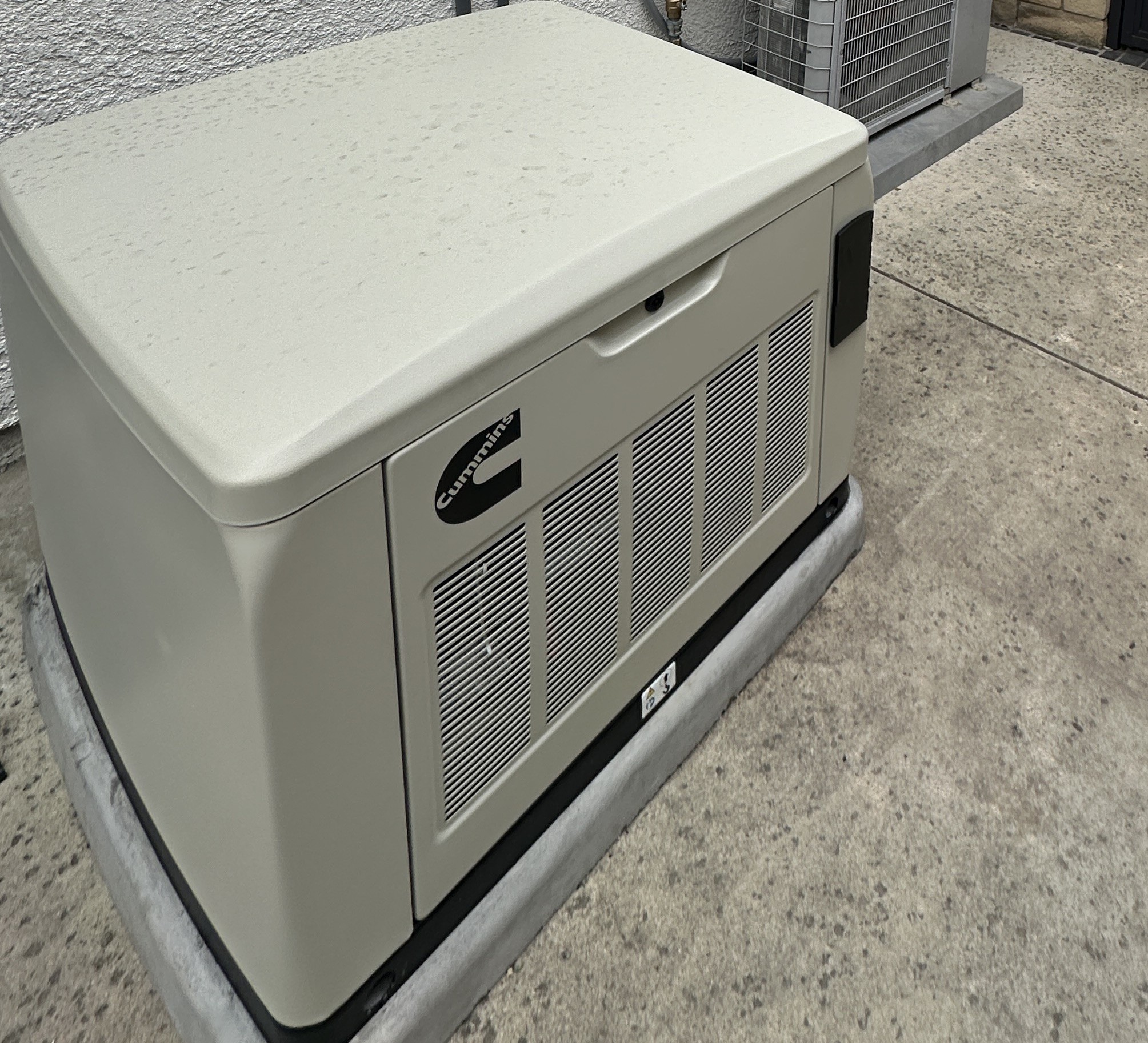
Option 3: Whole-home standby generator — Cummins QuietConnect. Natural gas-fed (or propane in the canyon zones without gas service), permanently installed, transfers automatically in 10-15 seconds, runs as long as the gas keeps flowing. We're an exclusive Cummins dealer, and Cummins is what we install on virtually every Calabasas job. See our full standby generator installation service page for the engineering details, or jump straight to the Cummins QuietConnect lineup.
Option 4: Hybrid — battery + standby generator. Best-in-class for homes that already have solar. The battery (Tesla Powerwall 3 or Franklin WH) handles the first few hours silently. The Cummins generator kicks in for sustained outages. We're installing more of these every year. Cost runs $35,000-$55,000 depending on battery count and generator size.
If your bills are above $400 a month, you have someone working from home, or you've already lost $5,000+ to a previous outage, the math on Option 3 or 4 is straightforward.
Sizing for a Calabasas Home: The Real Math
The Cummins QuietConnect RS20 (20kW, air-cooled, Onan-engine) is the workhorse for most Calabasas homes between 2,500 and 5,500 square feet. It runs two AC compressors, a kitchen, lighting, and essentials simultaneously. The QuietConnect line is the quietest residential standby on the market — about 65 dB at 23 feet during normal operation, which matters more than most homeowners realize when the unit sits 10 feet from a master bedroom window or a neighbor's property line.
For smaller homes (under 2,500 sq ft) or essential-loads-only setups, we step down to the Cummins RS17 (17kW) or RS13.5 (13.5kW). For larger homes above 5,500 sq ft — three HVAC zones, a saltwater pool, a guesthouse — we step up to the liquid-cooled Cummins RS25, RS30, or RS36. The liquid-cooled models handle continuous load duty better and have substantially longer service intervals; Onan-engine maintenance runs 200 hours vs. 100 hours on most air-cooled competitors.
Brand honest moment: we're an exclusive Cummins dealer and Cummins is our default recommendation, but we also install Generac and Kohler when a homeowner specifically requests one — usually for warranty continuity on a replacement, or to match an existing fleet on a multi-property estate. And we're trained Generac service dealers, so if you already have a Generac and need warranty work, code diagnostics, or scheduled maintenance, we can handle that too — you don't have to wait for a Generac-authorized servicer with a 6-week backlog. Being a direct Cummins dealer means we carry Cummins parts in-warehouse, our techs are factory-trained on the Onan engine platform, and warranty claims go through us instead of a third-party servicer. That matters when a unit throws a code at 2 a.m. during a wind event.
Here's something a generalist contractor won't tell you: the gas meter has to be upsized if your combined BTU demand exceeds what your existing meter can deliver. A standard residential meter in Calabasas is a 250-class — about 250 cubic feet per hour at 7" water column. A 20kW Cummins running at full load consumes about 305 cubic feet per hour on natural gas. Add a tankless water heater (199 kBTU = ~200 cf/hr), a furnace, a range, and a pool heater all running at once, and you're past the meter's capacity by a wide margin.
SoCalGas calls this a "load survey." We do it on every Calabasas bid. If the demand is over capacity, you need a meter upgrade (free from SoCalGas, but it takes 4-8 weeks to schedule) before the generator can be commissioned. The contractors who skip this step end up with units that surge, throw error codes, or simply won't run under load. We've replaced three regulators on units installed by other companies in 91302 in the last 18 months alone — none of them ours.
Permits, HOAs, and the Calabasas Setback Rules
Calabasas building department reviews every standby generator install. The permit itself runs $400-$700. The inspection happens after the pad is poured and the gas/electrical rough-in is complete, then again at final.
Setbacks you need to know:
5 feet minimum from any operable window, door, or fresh-air intake (per IRC 2022, adopted in Calabasas)
18 inches minimum from the structure on the service side for maintenance access
3 feet from the property line in most R-1 zones
Noise: 65 dB at the property line during exercise cycles (Calabasas Municipal Code 8.32)
Hidden Hills HOA has additional rules. The Mountain View Estates HOA in north Calabasas requires a specific landscape screen. The Saratoga Ranch HOA requires the generator be on the side of the house away from the street. We handle all of these reviews — it's part of every bid.
What It Costs in Calabasas Specifically
Calabasas installs run higher than the LA county average because of the gas line work, the HOA requirements, and the longer trench distances on hillside lots. These are real numbers from our Cummins installs in 91302:
Cummins RS13.5 / RS17, essential-loads setup on a flat lot: $13,500-$16,000 turnkey
Cummins QuietConnect RS20, basic install on a flat lot, existing gas capacity: $15,500-$18,500 turnkey
Same RS20, hillside lot with 40+ ft trench and meter upgrade: $20,000-$24,500
Cummins RS25 liquid-cooled, gated estate: $24,000-$30,000
Cummins RS30 / RS36 liquid-cooled, full estate load: $32,000-$48,000
Cummins + Tesla Powerwall 3 hybrid (or Cummins + Franklin WH battery): $38,000-$54,000
These numbers include the unit, an automatic transfer switch (we typically pair Cummins with a 200A or 400A Cummins-rated ATS for whole-home coverage and seamless brand warranty), concrete pad, gas plumbing, electrical, permit, and inspection. They don't include sub-panel upgrades if your existing panel is a Federal Pacific or Zinsco — those need to be replaced before any generator install, and that's another $4,500-$7,500.
If you're cross-shopping a Generac 22kW Guardian against our Cummins RS20: the 22kW Generac edges out the RS20 by 2kW on paper, but the RS20 handles the same residential load envelope on virtually every Calabasas home we bid — and it runs noticeably quieter. Install cost difference between equivalent jobs typically runs $1,000-$2,000 in either direction depending on the installer's experience with the Onan platform and their dealer relationship. A non-dealer installing a Cummins unit pays retail for parts and routes warranty claims through a third party. We don't.
For a deeper cost breakdown across the LA region, the whole-house generator cost in California guide walks through the same math on Malibu and Pacific Palisades jobs.
How Long Until You're Protected?
Calabasas timeline, start to finish:
Site visit and bid: 2-3 days from your call
Permit submittal to Calabasas: 1-2 weeks for issuance
Cummins QuietConnect RS20 lead time: currently 2-3 weeks (we hold dealer inventory, which is often faster than the open-market Generac queue)
Install day: 1-2 days of work
SoCalGas meter upsize (if required): 4-8 weeks
Final inspection and commissioning: same week as install completion
Realistic total: 5-10 weeks from first call to a running, transferred unit. If you wait until the first Red Flag Warning in October, you're going to be in the dark for at least one shutoff before you're protected. Every year I get calls in mid-October from people who want a unit installed before next week's wind event. It doesn't work that way.
Get on the calendar now. Call (818) 606-8651 to schedule a Calabasas site visit this week.
What to Do Before Your First Site Visit
Three things make the bid faster and the install cleaner:
Pull up your SCE bill and find your service amperage (200A or 400A — it's on the meter)
Find your gas meter and note the class number (250, 425, etc. — stamped on the regulator)
Take a photo of your main panel with the cover off so we can see breaker brands and busbar condition
If your panel is a Federal Pacific Stab-Lok, a Zinsco, or a pre-1990 Square D QO with double-tapped breakers, we'll need to plan the panel upgrade into the same visit. That's not a generator problem — that's a 30-year-old electrical system at the end of its life that any insurance carrier in Calabasas would flag.
Bottom Line
PSPS shutoffs in Calabasas aren't going away. SCE has publicly committed to expanding the program, not contracting it. The wind events are getting longer. The fire-zone footprint is getting bigger. And the cost of an extended outage on a Calabasas home is now well into five figures.
A properly sized, properly permitted, properly gas-engineered Cummins QuietConnect is the only solution that genuinely runs your house for the full duration of a multi-day shutoff — and as an exclusive Cummins dealer, we install them every week in 91302. We'd rather quote yours in May than in October.
Call (818) 606-8651 for a same-week site visit, or request a Calabasas quote here.
RC Generators & Electric is a CSLB-licensed (#1105336), Tesla-certified electrical contractor and exclusive Cummins QuietConnect dealer serving Los Angeles, Malibu, Ventura County, Calabasas, Hidden Hills, Pacific Palisades, Westlake Village, Agoura Hills, Thousand Oaks, Camarillo, Beverly Hills, Brentwood, Encino, and Tarzana. We are certified to install Cummins, Generac, and Kohler whole-home generators, Tesla Powerwall and Franklin WH home batteries, and Lutron lighting control systems — and we are trained Generac service dealers for warranty and maintenance work on existing units. Owned by Gabriel Camarillo. 80+ whole-home generator installs and counting.